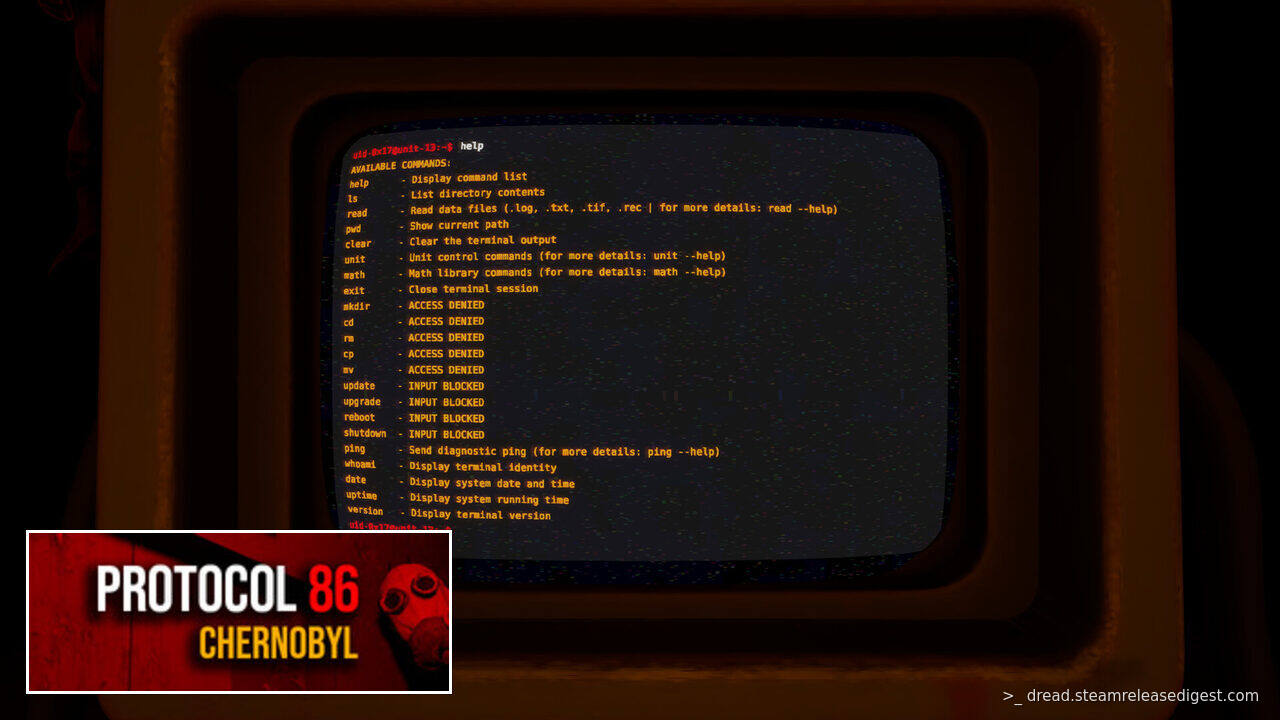
Typing help into a flickering, monochromatic command line as the Geiger counter ticking behind the drywall grows louder is not how most post-Chernobyl games begin. Where standard shooter tropes offer an assault rifle and a radiation suit, Core Interactive’s Protocol 86: Chernobyl locks you in a chair deep inside TROYKA—a secret underground Soviet research facility—and gives you nothing but a terminal prompt to negotiate your survival. It trades twitch reflexes for command syntax, asking you to parse directory trees while armed men and stranger, quieter threats move through the concrete corridors outside your door.
Set during the chaotic dissolution of the Soviet Union in late 1991, the game casts you as a trapped survivor hunting for an exit through procedurally shifting facility sectors. Gameplay unfolds entirely through a simulated, Linux-style command-line interface. You navigate file directories, read .txt emergency logs, view static-choked .png schematics, and play distorted .wav audio files left behind by doomed researchers. Progression isn’t about clearing a room of enemies; it’s about solving intricate system puzzles under ambient pressure, using file contents and hidden logs to deduce sector passcodes and override lockouts before your location is compromised.
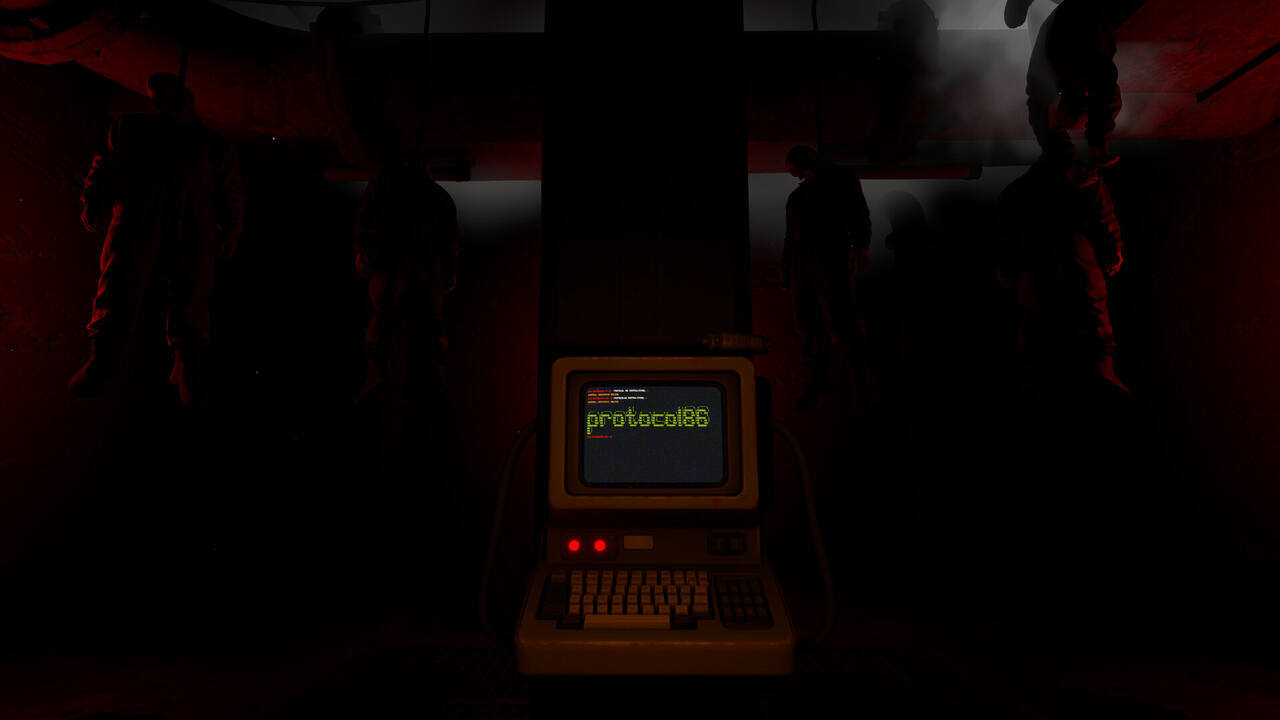
The core tension comes from the stark contrast between the sterile logic of the terminal and the eerie sensory environment leaking into your headphones. As you execute commands, the game relies heavily on dark sound design to build dread. You hear the heavy thud of military boots in adjacent hallways, distant screams echoing through concrete shafts, and the distinct, rising crackle of radiation leak warnings. The inclusion of authentic Russian voice acting grounds the setting in a palpable historical paranoia, making the underground facility feel like a buried tomb being violently erased from the state archives.
Players who enjoy retro terminal interfaces have highlighted the game’s authentic mechanical feel. Rather than simplifying the system into a basic point-and-click menu disguised as a computer, the interface expects players to actually learn and enter commands. Thoughtful additions like a tab-autofill button prevent the typing from feeling tedious without stripping away the satisfaction of manual system navigation. The puzzles hit a satisfying middle ground—demanding logical deduction and careful reading—with enough hidden files and extra achievements scattered across the directories to reward thorough investigation during a three-to-four-hour run.
However, the game’s design decisions create a sharp point of friction for some. The most vocal player complaint centers on its unforgiving lack of a save system. Protocol 86: Chernobyl operates on a strict permadeath model: a single mistake or an unexpected encounter with roaming hazards—such as a hostile, radioactive entity stalking the sectors—wipes your entire run and forces you to restart from the initial prompt. For a atmospheric puzzle game that requires slow, methodical reading of text files, losing several hours of progress to a sudden death can feel brutally punitive, turning tension into frustration for players caught in a repeat loop.
Protocol 86: Chernobyl is a focused, niche experience tailored for players who find dread in isolation, command lines, and quiet retro-tech atmosphere. If your taste in horror skews toward the slow-burn, text-driven claustrophobia of games like Stories Untold or Duskers, this low-cost Soviet mystery delivers a distinct sense of place. It requires patience and a tolerance for ruthless restarts, but its oppressive, cold-war mood lingers well after you close the terminal.
Key Facts
- Developer: Core Interactive
- Publisher: Core Interactive
- Release Date: September 24, 2026
- Price: $6.99